Showing posts with label Elm. Show all posts

Saturday 25 July 2015

Removing sick Elm trees

We cleared out some sick Elm trees from the river bank this week. It is all part of the programme to open up the river bank down at the Turnditch Orchard Project. We used cable winches to prevent the trees falling into the river and a chain saw to cut the trees. I made good use of my new wader boots as the dummy in the water. 


It is a lot more open than it used to be when we first took possession of the field. There's a couple of pictures below showing the before state.

The river bank before cut back. Notice the marked trees.

Our dog getting ready for a paddle.


There is of course a very large pile of wood now awaiting destruction by burning on site. We don't want to risk spreading the disease any further. I'll devise some kind of furnace to keep the fire temperatures high. Elm is usually not a very good firewood, if left to its own devices it usually produces a lot of acrid smoke when it burns in an open fire.

This tree removal work will make space for us to introduce some erosion control on the river banks.

Tuesday 7 April 2015

Tidying the river bank

Yesterday we finally got around to taking down one of the small Elm trees on the river bank. I'd noticed last year the leaves were heavily wilting at the end of the year. The tree is of the age where the bark is hard enough for the Dutch Elm Disease beetle. It was a slightly tricky felling as the tree was both bifurcated and over-hanging the river. The river is running too fast to stand in at the moment.  However a combination of an old ladder section propped against the bank and my trusty cable winch provided the solution and the tree was felled after a couple of minute's work with a chainsaw.

Inspection of the felled tree showed that most of the branches had died already, with just a few spouting buds. We need to clear the bank so we can install some erosion controlling willow spiling in the banks. We'll destroy the Elm wood by fire on the orchard site to avoid spreading any disease.

We're pleased to note the fruit trees we have planted are all looking healthy this year and are beginning to sprout leaves.


Saturday 19 July 2014

Elm trees diseased and need removal

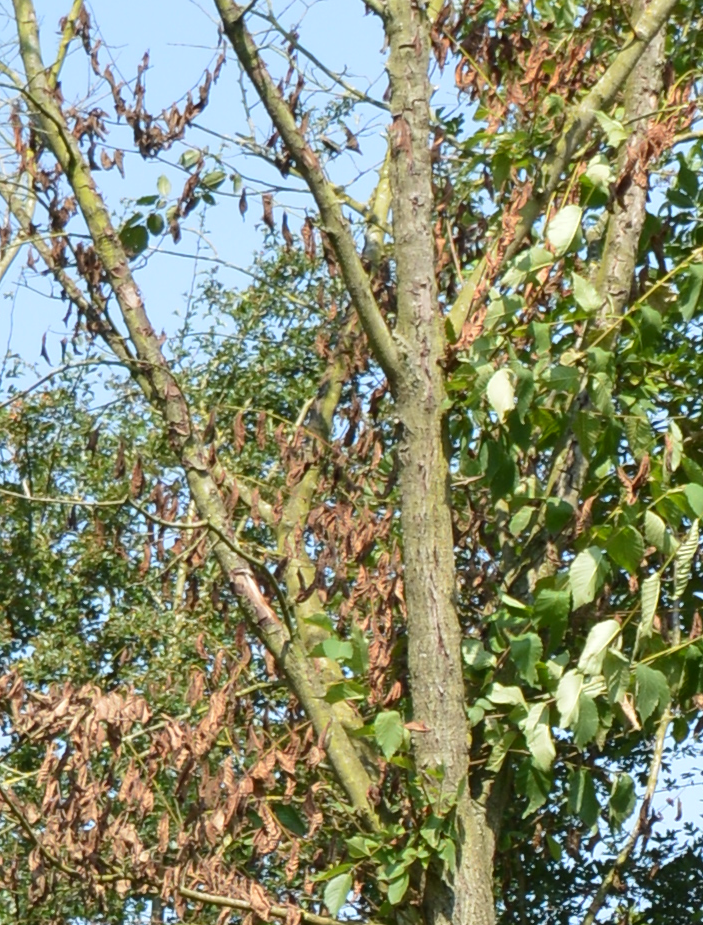
It is clear on in inspection some of the small elm trees near the river have become diseased and should be removed. This summer they suffered sudden and severe leaf wilt.  I've marked the affected ones with arborist spray paint (blue) and as soon as the bird nesting season is over we'll be in with the chain saw, winches and ropes to remove the affected trees. They are clustered around the river end of the field.


Diseased and wilted Elm leaves in Turnditch orchard
Wilted Elm leaves at the Orchard

We'll dispose of the diseased wood on site in large bonfires. This will avoid spreading the infection elsewhere. It is a pity to destroy elm trees which are no longer a common species, but if they are infected there is no option.

I saw some trout in the river Ecclesbourne while I was checking the trees. The water level is at the summer lows at present, so in places it is only a few inches deep, but the fish seem happy enough. They looked like brown trout. Part of the river bed is now above water. It looks like crushed stone debris. Possibly the debris is the result of the river bank erosion caused during the winter flooding. It demonstrates the need to undertake some bank reinforcement works with live willow spiling.

Tuesday 15 July 2014

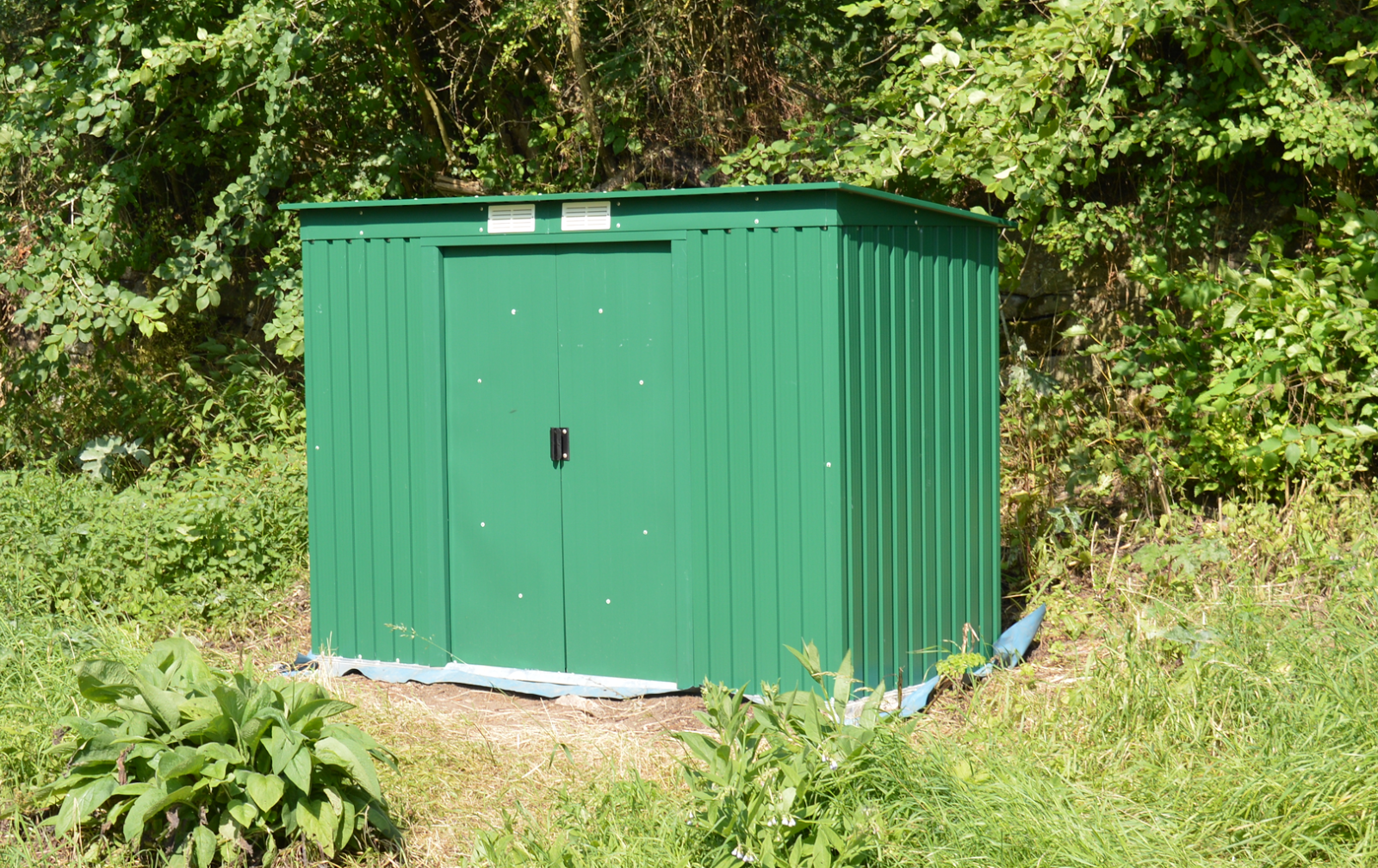
Finally building the tool shed

We've been able to spend some more time in the orchard. This time the focus was on building the tool shed. It was a flat pack metal construction. The package was too heavy for one person to lift, so we ferried it in sections to the site over several trips. My wife is greatly pleased it is no longer cluttering the hallway in Belper.

I'd laid a concrete base last November which had been hiding and curing under a plastic sheet until now.  So we at least had a head start on the construction process. I was a bit worried the base might not have been accurately laid, but my fears were unfounded. The shed assembly process showed only tiny inaccuracies in the concrete base. I've built in some security features which are not obvious to casual inspection from the outside of the shed. We are also using Smartwater to mark any items temporarily stored in the shed.

According the instructions contained in the pack the assembly process is listed as taking 3- 5 hours by two people. I feel that figure is rather optimistic. It might be true on the factory floor by two experienced personnel, but we have spent far longer in reality. The instructions were surprisingly clear with only a couple of errors. Some of the time has been spent talking to people from the village who pop by and are quite intrigued to find out what is happening at the orchard site.

The completed tool shed in Turnditch Orchard
The completed tool shed


I 've taken to running a small wood fire while I was working on the shed. The smoke seems to successfully deter annoying biting insects from lurking on the trees in the area. We've using a small incinerator bin for the gradual removal of odd pieces  of wood from fallen branches and trees that we've cut down. While we've been working I have noticed the Elm trees are not at all healthy and have suffered sudden wilting. I'll be removing those quite soon as they must be a source of infection. It is a pity.

The shed dimensions or an 8x4 ft base with a height at the front of 5 ft at the front of the sloping roof, so it is not quite high enough to stand up in.

Sunday 26 January 2014

Rotten trees in the roadside hedge

The fencing contractors employed to install the wire stock fence, on the roadside of the orchard site, cut back some of the hedge bushes. This was fine by us. They needed relatively straight lines of sight for the fencing process which involves tensioning the wire. 

However the trimming back exposed several small trees of up to 15 cm (6 in) diameter which were rotten through to the core. I was able to push these trees over by hand. They then fell down the embankment into our field site. It would not have been good if winds had pushed them in the opposite direction on to the road. It is yet more urgent work needed to tidy the woodland on the embankment. The rotten trees were mostly Elm and Hawthorn. I'll collect the rotten trunks and store them either on the embankment or in a corner of the field so any wood boring grubs inside are not disturbed.

We'd intended to do this tidying work during November and December of last year but the temporary loss of my driving licence (a single 30 second blackout) has greatly impaired our ability to transport equipment to the site. Hopefully the Government officials will decide I've been punished enough for the single isolated health event and return my licence to me. Otherwise progress on the work of setting up the orchard will be impaired. It is unlikely the orchard will ever generate enough income to pay for the extensive use of contractors. There's just a couple of months left before the birds nesting season starts which will put a stop to any major works in the woodland.


Sunday 17 November 2013

More trees down

We managed to do some work on the orchard site today. We took down three small trees (2 elm and one hawthorn) and logged them into convenient lengths. The selection of these trees was to open up the access space. My wife discovered the joys of hawthorn thorns! 

The more often we see the road side hedge the greater the realisation how poorly the land has been maintained in the past few years. There are some large gaps and a lot of dead wood.

We're trying to create a stockpile of poles suitable for the uprights in the hedge laying process. Trunks which are too thick are cut into shorter lengths and stacked for seasoning as fire wood. I forgot some of the chainsaw lessons while tidying the branches and managed to cause the chain to jump off the chainsaw bar. I'll be doing some chainsaw servicing tonight. 

We've also ordered 220 metres of 16mm Polysteel rope and a manual 4 ton winch, these will be used in the process of directional felling of the trees close to the road. It is all part of the coppicing work. I'll be brushing up my rope skills such as eye spicing thimbles in at the ends of the ropes.

We performed some brush cutting to chop down some more of the jungle (grass, thistles, cow parsley etc., but kept the session short so the noise didn't disturb the neighbouring homes too much on a Sunday. The soil looks to be good quality alluvial loam which bodes well for the fruit trees of the orchard. We should also be able to plant some herbs between the trees as a crop.

This week we've seen an owl and pheasant on the land, plus all of the other usual small birds such as blackbirds, robins and blue tits. When we deal with the coppicing of the trees we'll keep an eye out for nesting places and preserve if possible or provide an alternative. 

Sunday 20 October 2013

First trees down

We're making slow progress on the site due to the poor weather. We are not being total wimps just because of some rain, but we are taking heed of the safety warnings of not using power tools such as the chainsaw in wet conditions. However we have used a bow saw to take down three small elm trees. We've left them as coppice stumps/stools. The trees were saplings really, with  only 10 cm diameter trunks but were growing out of the base of the wall. Potentially if left unchecked they'll damage the wall on that part of the field. Some of the branches had died. We'll check the regrowth on the stools next year and subsequent years to see if the elm is disease free.


The small branches will be chipped, but the thicker elm is hopeless as firewood. It would burn slowly and with a lot of smoke. We'll keep the trunks as long elm logs for use in the base of the wood piles. Elm wood has a good resistance to rotting. We'll pile more valuable wood on top for seasoning. 

While the elm trees were not part of the roadside hedge, the reduced foliage after their felling has exposed the rather poor state of that hedge. It emphasises the need to provide a secure fence as there is quite a steep drop into the field. The rolls of stock fencing have arrived and we hope to start work soon, but the first priority is the completion of the secure storage unit.

I've performing research into manual cable winch units for the logging work. When we take down trees close to the road and the river we'll need directional control to prevent the trees falling in the wrong direction. I've settled on a Tirfor winch with wire cable, now the problem is to source one inexpensively through rental or purchase.

Wednesday 2 October 2013

The Orchard - We've started clearance work.

Yesterday we started the process of clearing the plot in preparation for planning the orchard. The picture below is the strip of land next to the River Ecclesbourne. One of the local farmers has a right of access to his fields through this strip. We managed to to clear back about 80% over the undergrowth in the available time.


Given the uncertainty of what is hidden under the grass and brush we only using hand held tools to clear the ground during this first pass. We were using a Kawasaki KBH27 brush cutter and managed to burn through two tanks full of petrol in the clearing process. We're raking up the felled vegetation and will be hot composting it later. The brush was mostly grass, nettles and some Himalayan Balsam. The Himalayan Balsam is an invasive species and will take a few years of repeated strimming to eradicate.  Given the proximity of the river spraying with chemicals is not an option.

We'll be relaying the hedge on the left hand side of the picture at some point soon. It looks like there's been no proper hedge maintenance for a good few years.  I was pleased to note there is some healthy looking English Elm saplings forming part of the old hedge. We'll do what we can to preserve this species of tree. The question is should we lay Derbyshire Style or Midlands style, I was raised in Buckinghamshire so I prefer the Midlands or Southern Style hedging. 

We also need to have a missing gate post installed in the entrance to the main field to enable us to rehang the steel gate which we found laying on the ground.