Showing posts with label coppicing. Show all posts

Saturday 7 March 2015

Clearing the river bank

I was able to put some time and effort into clearing unwanted trees from the river bank at the Turnditch orchard. The purpose of the clearance is to give some light for willow. We intend to plant the willow as woven spiling to protect the river bank from further erosion. This part of the River Ecclesbourne is prone to scour after the bridges in the fast flowing winter spate. 

We are initially removing some large hawthorn bushes which are overgrown, tangled and threatening to fall over into the river. We cannot simply fell the bushes as the weight of the top growth would cause them to topple into the river and make recovery much more difficult. Even directional felling cuts would not guarantee a safe or convenient fall of the bush. These bushes are about 20 ft (6 metres) tall and probably weigh about one tonne. They each have several upright trunks clustered around a root.

To achieve safe removal we're using cable winches to apply tension from the best direction. Once the trunk is under tension using a chainsaw we apply a partial felling cut, but not enough to fell that section of the bush. We then retire to the winch and increase the tension until the trunk disentangles from the top growth and falls. Using the winch we pull that section of the bush to a safe place where we can cut off branches then cut up the trunk. We are using an indirect pull from a cable winch and steel wire. The direction of the pull is set up using a snatch block pulley anchored to a convenient place.

We are delivering a coppice type cut to the hawthorn. It should allow them to regrow, but this time the process will be managed!
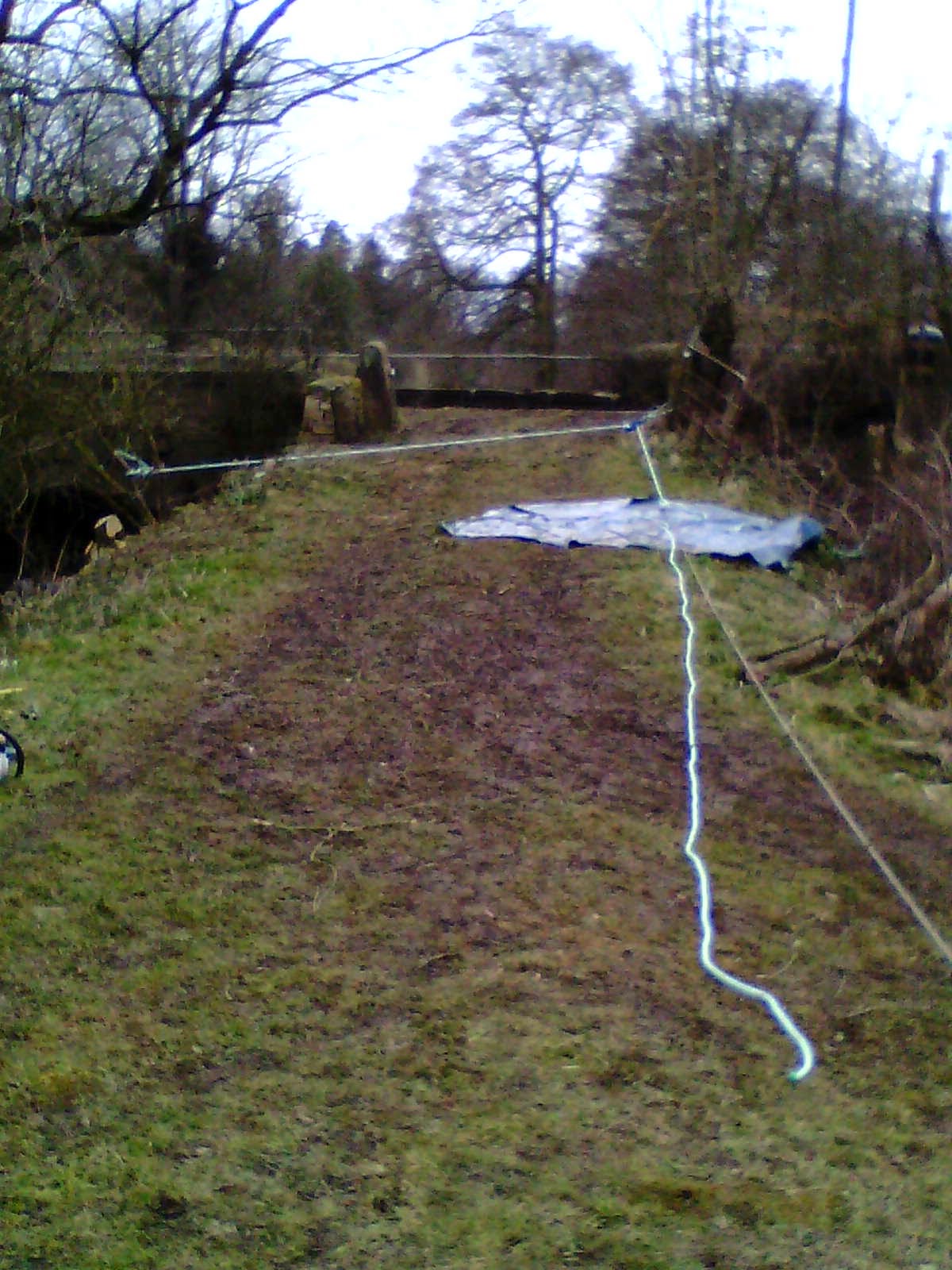


View of indirect winch set up.
Indirect winch arrangement

The snatch block anchored to old gate post:
Snatch black anchoring
The cable winch:
Cable winch anchored to ash tree
Applying tension to the bush:
Apply tension prior to cutting

The next step will be to remove half a dozen small Elm trees on the river bank. I noticed last year there were badly wilting which suggests they have Dutch Elm Disease. We'll burn the wood on site to prevent any further spread of this tree disease.


Monday 11 August 2014

Important Hedge in Turnditch Orchard.

It turns out the hedge we had re-laid is an "Important Hedgerow" under the terms of the  Hedgerows Regulations 1997 which were made under Section 97 of the Environment Act 1995 and came into operation in England and Wales on 1 June 1997. The hedge forms the boundary between our orchard and the farmer's fields to the south. As such it is protected from removal and destruction. 


The reason why it is classified as Important is it marks the boundary between two parishes prior to 1850, it being on the parish boundary between Turnditch parish and the Shotlle and Postern parish.


The hedge at the river end of the field is also under the same category because the public footpath runs closely parallel. Under the regulations having a footpath or bridleway close to the hedge makes it classified as Important and thus protected.


The trees in the woodland on the embankment adjoining the orchard are regulated under the Forestry Act 1967 which imposes limits on which trees can be felled. They control the amount of timber which can be felled (up to 5 Cu M per calendar quarter) and allow some exemptions for pruning, thinning, pollarding and coppicing. The plans we have for tidying and maintaining the woodland will fall within the exemptions. We are planning gradual coppicing spread over three years. It does does however mean we'd have to apply for a felling licence if we were to need to fell the large old Ash tree on the south hedge.

Tuesday 24 June 2014

Local angling club pays a visit

I was hard at work cutting down overgrown grass and thistles in the orchard site yesterday when the officials of the local angling club paid a visit. We'd spoken on the phone before but it was good to meet them in person. They were spending some time cutting down Himalayan Balsam while awaiting delivery of 200 young grayling fish. They are re-introducing the grayling into the River Ecclesbourne. The young fish had been raised in a local fish farm using grayling parents borrowed from the nearby River Derwent. I was leaving for some well earned lunch just as the car arrived carrying two large plastic bags containing water and fish. The release of fish was supervised by the local nature conservancy organisation.

We are really pleased with the progress of the hedges which we'd had relaid earlier this year. There are some gaps in the hedge we'll need to deal with, but overall it has been very successful. Even though it seemed expensive at £11/metre compared with wire stock fence at £4/metre the results are worth the extra expenditure. 
Ash shoots in relaid hedge

We particularly pleased that the ash trees which were extensively damaged by sheep during the winter have pulled through and are successfully sprouting after pleaching and laying of the restored hedgerow. The hungry sheep had almost completely ring-barked the trees. In the picture below you can see the see the same tree/sapling after the sheep damage (it is the thicker light brown trunk).


We're still waiting for a quote from a local fencing contractor to provide a stock fence to protect the hedge from grazing animals. It's only been three months delay so far! This chap was recommended by our neighbouring farmer, but it is stretching our patience a bit, so we'll probably go back to the contractor we used for the roadside stock fence. 

Last autumn we experimentally felled three Ash trees to evaluate how well they'd respond to coppicing. During the past couple of days we've noticed there is some lively regrowth around the base of the felled tree.  This is important as we want to make sure the trees on the embankment slopes continue to live after coppicing. If they die away it could be bad for soil stability.

We're not completely mowing the field. We're leaving some stands of grass and natural plants we'll allow to grow to full height. This will help to improve diversity while not allowing the weeds to rampage.

Tuesday 17 December 2013

Sheep 1 Orchard Site 0

We visited the site today and found three sheep on the land. Our fence repair is intact so they must have found another route on to the land. They soon retreated when we started a chain saw to do some work. We don't want to panic them because at this time of the year they are probably pregnant. 

We discovered the sheep had gnawed the bark from some off the branches we'd felled a couple of weeks ago. I'd imagine that unprotected fruit trees would suffer the same fate.

We spend a couple of hours cutting down small trees and working to tidy the embankment. It was mostly ash and hawthorn, but now there is a large pile of branches which need trimming and brushwood to burn or turn into wood chippings. It was hard work, with loads of thorns grabbing at us, but the result was satisfying. We removed four trees which were leaning over the fence and threatening long term problems. We cut their bases low in the normal coppicing style. It's far better to remove them now rather than waiting until the fruit trees are established.
Sheep Damage
In the picture you can see some of the damage caused to an Ash tree and an Elderberry shrub. The sheep have completely debarked a long section on each tree. Those trees will need to be dut down and coppiced to see if they'll recover.


Edit: 22/12/13 We met with Adrian, the guy who's going to lay the hedges. He told us sheep love to eat the bark from ash tree branches. Sure enough it was those branches in the log pile which the sheep had chewed.

Saturday 5 October 2013

Planning the Ashbourne Road orchard plot fence

We've reviewed the roadside hedge on the Orchard project. 

The approach road to the railway bridge creates an embankment leading from the River Ecclesbourne to the crest of the road bridge. 

To improve the natural environment, we're going to coppice the trees growing on the south side of the embankment. The tree canopy blocks out the light and reduces the variety of species growing on the south facing embankment. The existing trees appear not to have been managed for many years. Some of the taller trees overhang the road and railway. When we fell the trees to create the coppice stools we'll have to proceed carefully. We'll use wire cables and winches to ensure the tree fall where we want them to go.  We'll probably have to take out most of the trees progressively along the embankment working from the river end toward the railway. This is necessary to create the safe felling space for the larger trees. Within a couple of years though there will be substantial regrowth from the coppice stools, but in the meantime other natural species will have the opportunity to recolonise the embankment.

The roadside hedge needs a lot more attention before we'll have it fully restored. There are gaps from deadwood and also from damage caused by a road accident. We need to make the hedge stock proof, so we are planning to install a 90cm high galvanised wire stock fence along the roadside boundary extending from the river gate to the end of the rail bridge parapet. We measured this and discovered we'll need to install 108 metres of wire stock fencing. The need for the fence is improve public safety and to reduce the chance of livestock escaping on to the road. There is a fence lower down at the foot of the embankment slope, but we'll need, temporarily, to dismantle the fence during the coppicing process.

Once the fence is secure, we'll gradually work on restoring the hedge using traditional layering and replanting at the top of the embankment slope as necessary. Our estimate is it will take about three years before it starts looking like a reasonable countryside style hedge. We'll plant a variety of hedgerow saplings in increase disease resistance and also to provide better variety. Once the hedge is properly re-established we'll remove the wire fencing.

Monday 23 September 2013

Plans for use of the land at the Turnditch Orchard Project.

We've been asked what we are planning on the Turnditch Orchard Project.

The long thin rectangle shape of the land is not good for agricultural machinery techniques. It would be great for property development, but we've absolutely no intention of following that route. The land will remain agricultural and we intend to take a regular harvest from the land.


Present conditions

The site appears to have been neglected for many years. The level part is overgrown with uncut grass, extensive thistles and Alder shrubs. Many ants nests have made the ground very uneven. The road embankment, which forms part of the property is covered with unmanaged native tree, mostly English Ash and some Hawthorn. The hedges are unmaintained and ineffective. some of the trees tower over the Ashbourne Road (A517). Many of the fences are in poor condition and the stone posts to the entrance gate are damaged.

Planned actions
  • Clear the grass and weeds with a scrub cutter;
  • Create natural compost area
  • Repair the gate posts and gates;
  • Make the access secure;
  • Create a temporary tool store;
  • Take advice on the large old Ash tree;
  • Clean out the undergrowth and unwanted trees in embankment area;
  • Cut the chosen trees for coppicing;
  • Trim trees overhanging the road;
  • Restore the hedges;
  • Cut the wood into logs and store for seasoning
  • Turn unwanted wood into chips;
  • Turnover the level ground soil with Rotavator & check drainage;
  • Plant meadow seed, herbs and crops;
  • Restore fences;
  • Set up bee hives;
  • Create safe access to the river.
  • Select orchard trees for planting.
When these action are largely complete we'll discuss providing access to local villagers. The intention of coppicing is to provide greater nature diversity on the embankment and also provide a wood crop in the future years. It will look a little stark initially, but will provide some great benefits.


Sunday 22 September 2013

Fruits of the Orchard Project

We've already been able to gain some fruit from the Orchard project. Even though the gound is an overgrown jungle there are some native wild fruit bushes. Yesterday we were able to pick up 2.5 Kg of wild plums (Bullace) and 0.8 Kg of Dog Rose hips. The Bullace are quite sour, so they'll be turned into a form of Sloe Gin. The hips will be turned into syrup. Both a fragrant gift in time for Christmas.