Showing posts with label Ecclesbourne. Show all posts

Monday 28 March 2016

Floods at the Turnditch Orchard project

We called in at the orchard site  this morning. The Ecclesbourne River has overflowed its banks and some of the land of the orchard has been flooded. Storm Katie dropped a lot of rain last night and the river level flashed up by 150cms. As a consequence some of the fruit trees have their "feet" in water. Flooding can kill the trees, we'll have to wait and see how they survive.  

Longer term it may be worth opening up the old drainage ditch which runs across the orchard. It is fed by the culvert which was built when the embankment for the railway bridge was formed. Previous owners of the land have filled in the ditch, which was present on maps prior to 1850. Perhaps an opportunity for the volunteer work force to drive a small back-hoe excavator one day!

Saturday 25 July 2015

Removing sick Elm trees

We cleared out some sick Elm trees from the river bank this week. It is all part of the programme to open up the river bank down at the Turnditch Orchard Project. We used cable winches to prevent the trees falling into the river and a chain saw to cut the trees. I made good use of my new wader boots as the dummy in the water. 


It is a lot more open than it used to be when we first took possession of the field. There's a couple of pictures below showing the before state.

The river bank before cut back. Notice the marked trees.

Our dog getting ready for a paddle.


There is of course a very large pile of wood now awaiting destruction by burning on site. We don't want to risk spreading the disease any further. I'll devise some kind of furnace to keep the fire temperatures high. Elm is usually not a very good firewood, if left to its own devices it usually produces a lot of acrid smoke when it burns in an open fire.

This tree removal work will make space for us to introduce some erosion control on the river banks.

Saturday 9 May 2015

Dead lamb in the river

While I was loading the field trimming machine into the back of my car yesterday, after a grass cutting session at the Orchard, I noticed there was a dead lamb at the edge of the river. The animal looked to be about 3-4 weeks old and was marked with a blue number "8" on its back. I presume it was caught in the river upstream and drowned before being washed down. We've had a few days recently when the rain was heavy causing the river levels to swell.

I'm not sure who's responsibility it is to deal with the carcase. It's not our property and there are strict rules for the correct disposal of dead farm animals. These usually involve the services of a specialist contractor.

Monday 28 July 2014

Investigating the river

We spent Sunday morning at the orchard site. I'd been intending for some time to get my wellington boots on and go along the river during the low summer water levels. As long as I avoided the obvious deeper areas I was okay and didn't get boots full of water. The banks are about 2.5 metres above the riverbed and quite steep, I pre-fixed a knotted rope to a tree so I'd be able to climb out again. 

One side of the orchard is a road embankment which leads to a railway bridge from the river. The road was built across the floodplain when the railway was first built, so quite a substantial amount of landfill was used to create the "hill" leading to the bridge. The bottom section of our field which forms the river bank has also had some build up of fill to allow access to the  road. It looks like the fill material was quarry chippings. Over the past 150 years this has been overgrown and no longer looks artificial. However when the river runs in full spate in the winter rains it fills almost to the top of our river banks. The river is a very different beast from the gentle brook of the summer months. The flooding causes erosion of the material dumped to form the ramp up to the road. 

Riverbank washout
Wash-out of the river bank

The washed out materiel is then dumped on the river bed. You can see the results of this in the above picture. The rubble is limestone chippings and appears to have built up above the normal level of the river bed. The picture below shows the roots of elm trees which have been exposed by the erosion of the bank during periods of river spate/flood.


Erosion of tree roots River Ecclesbourne
Eroded tree roots on the river bank

We'll be removing these compromised trees in the autumn and as mentioned in an earlier blog replacing them with  live willow spiling to control the erosion of the river bank. During this inspection process I was assisted by two young apprentices. They  seemed to be intent on making much splashing in the river.

Apprentice river bank surveyors

We also managed some weed clearance, particularly the Himalayan Balsam  which is an unwanted invasive species. This is going to be an on-going battle because the weed is is rampant upstream and down stream of our site. We can at least prevent the seeds being formed on our land. There are some legal responsibilities in dealing with this weed.

Himalayan Balsam on the river bank


Monday 3 February 2014

Riparian owners in an orchard.

We did some research on the responsibilities and rights we gained when we took on the plot of land at the edge of the Ecclesbourne River. Officially at the place of our orchard it is a watercourse and not a river. The following is a summary and not necessarily correct legal advice on our part.

Riparian Owners 
You are known as a riparian owner if you own land or property adjacent to a watercourse. By virtue of being a riparian owner you have rights and responsibilities.

Your rights as a riparian owner are

  • You are presumed to own the land up to the centre of the watercourse, unless it is known to be owned by others.
  • You have the right to receive flow of water in its natural state, without undue interference in quantity or quality.
  • You have the right to protect your property from flooding, and your land from erosion. You will in most cases need the prior consent of the Environment Agency and Local Authority for any works, however. In the case of The Ecclesbourne at Turnditch it is Derbyshire County Council.
  • You have the right to fish in your watercourse, although this must be by legal methods and with an Environment Agency rod licence.
  • Without needing a licence, you can abstract a maximum of 20 cubic metres of  water per day for the domestic purposes of your own household or for agricultural use, excluding spray irrigation, from a watercourse at a point that directly adjoins your land. Most other types of abstraction will require a licence from the Agency. 

Your responsibilities 

  • You have the responsibility to pass on flow without obstruction, pollution or diversion affecting the rights of others. 
  • You have the responsibility to accept flood flows through your land, even if caused by inadequate capacity downstream, as there is no common law duty to improve a watercourse.
  • You are responsible for maintaining the bed and banks of the watercourse (including trees and shrubs growing on the banks), and for clearing any debris, natural or otherwise, including litter and animal carcasses, even if it did not originate from your land. 
  • You must not cause any obstructions to the free passage of fish. 
  • You are responsible for keeping the bed and banks clear of any matter that could cause an obstruction, either on your land or by being washed away by high flow to obstruct a structure downstream. Watercourses and their banks must not be used for the disposal of any form of garden or other waste. 
  • You are responsible for keeping clear any structures that you own such as culverts, trash screens, weirs and mill gates. 
  • You may have flood defences such as walls and embankments on your property, which are vital for the protection of both yourself and others. You should discuss the maintenance of such defences with the Environment Agency office. 
  • You are responsible for protecting your property from seepage through natural or man-made banks. Where such seepage threatens the structural integrity of a flood defence, it may become the concern of the Environment Agency. 

Snowdrops at Turnditch Orchard

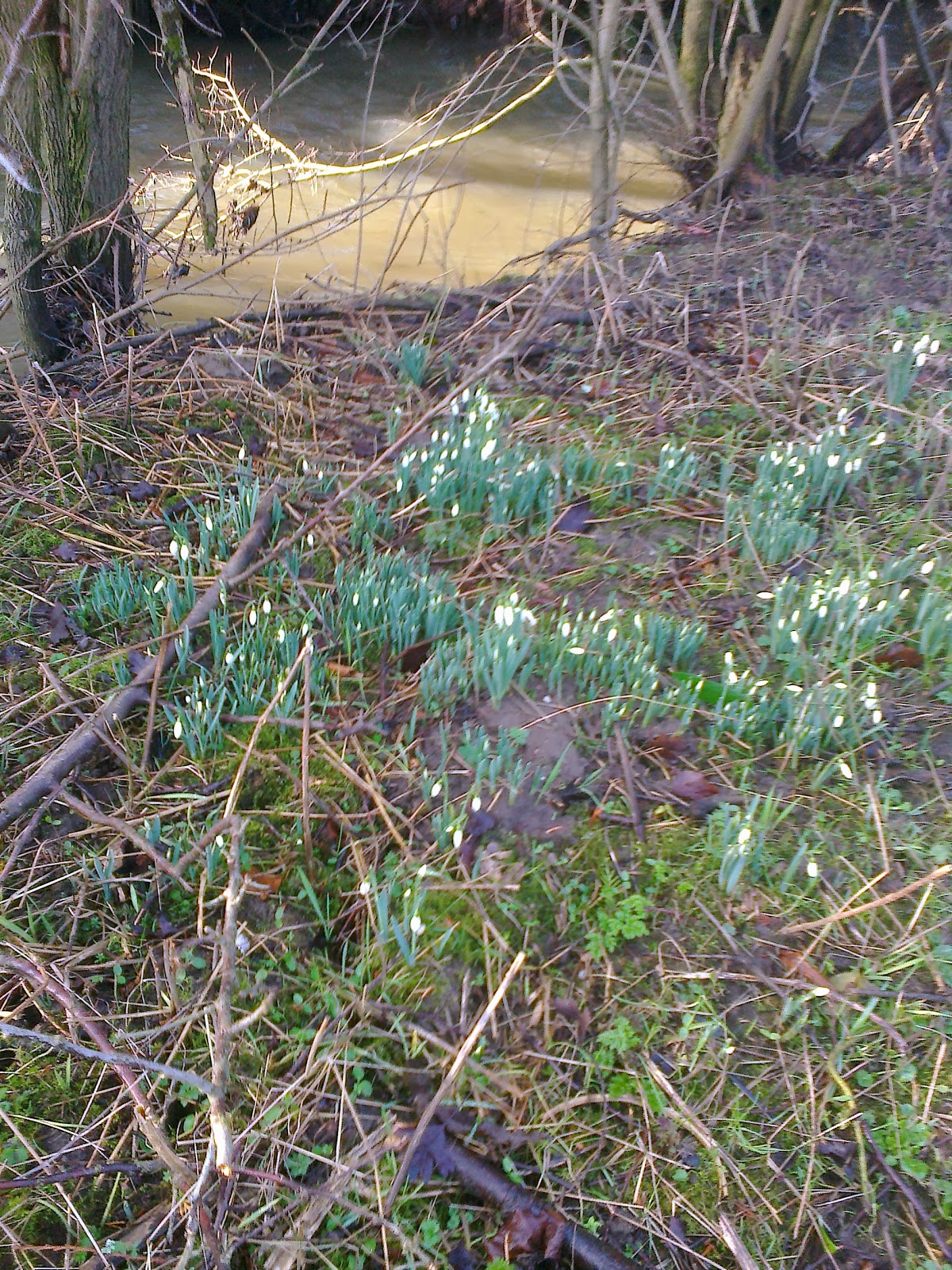
There's signs of Spring already at the orchard. We found these snowdrops poking their heads above the soil on the first day of February. Behind the flowers you can see the Ecclesbourne swollen by the recent rains.

Snowdrops beside the Ecclesbourne
Snowdrops by the Ecclesbourne

Wednesday 22 January 2014

Early signs of spring

The river is still in spate today after the heavy rain over the past few weeks. The picture below shows the current level and some debris from a fallen tree.  This picture was taken from the road bridge. We're planing to clean the bank side and remove many of the failed trees. In their place we'll be planting some willow to consolidate the banks Their thick roots can withstand water logging in the soil and will dig down deeply binding the soil against flood erosion.


We noticed some snowdrop flowers on the field under the hedges and also in the open ground. You'd not normally find snowdrops in fields grazed by farm animals as they may be toxic. It is a further suggestion that some garden soil has been dumped on the field. I also noted some buds were beginning to swell on some of the twigs. Let's hope there not a cold spell in February to burn this sign of life.

Tuesday 22 October 2013

Will the site flood?

We did a brief site visit to assess the impact of the past few days of heavy rain. The River Ecclesbourne is now running fast and a lot deeper than its normal state.


However the river would need to rise about another metre before any flooding takes place, so at the moment no major worries.

Note 1/11/2013:
I have made a note later in the blog about river bank erosion. You can just see some of this erosion where the Elm sapling grows in the above picture. The bank are about 2 metres and pretty much vertical above the river bed. During the summer the edge of the river is only 5 cms deep so the spate condition must be at least a metre deep and fairly fast flowing. The opposite bank has some stonework and steps to provide access and some protection against erosion. The general state of neglect by the previous owner(s) of the field and river bank will need some remedial work to prevent further damage.

Friday 20 September 2013

The seeds of a plan to create an orchard in Turnditch.

Welcome to the Turnditch Orchard Project. Turnditch is a small village in Derbyshire

We recently saw a small plot of agricultural land on the eastern outskirts of Turnditch village for sale by auction. It adjoins the Ecclesbourne River at one end and the north side has the Ashbourne Road (A517) as a boundary. At the east end the boundary is the Ecclesbourne Valley Railway. The land is about 0.8 acres (0.3 Hectares) in area. A footpath crosses the westerly end of the plot next to the river.

We've recently moved to Belper as semi-retirement from busy careers in London. When we saw the land we thought it would be a ideal plot where we could create an orchard. On inspection the land was found to be overgrown and shows years of neglect.

Site of the Turnditch Orchard Project

We made a bid at the auction and won the plot. After the usual legal palaver and a handover of a cheque the land is now ours. Now the hard work starts to clear the land and begin the process of creating an orchard. 

This blog will be a record of the progress. We've no intention of developing the land other than the orchard and will be looking at ways to provide access to the local primary school.