Sunday, 23 February 2014

Where's a northerly wind when you want one?

We were working to clear some of the trimmings from the hedging process yesterday. We needed to burn some massive piles of hawthorn and blackthorn branches. Unfortunately we really need to have the wind coming from the North West so the smoke from the bonfires does not drift across the Ashbourne Road. Mostly this winter it has been coming from the South West.

We'd gathered a large pile of Ash branches fallen from the large old tree and dragged them to form a bonfire, as yet unlit, to form the nucleus of heat to burn the thorn bush branches. We'll need a large hot fire to get the process going, but once it has started it will just be a matter of feeding the fire with branches. We think it is about two days solid work to move all of the thorn branches. We've located the bonfire site on a patch of Alder which had grown up during the period of the neglectful owner. This will be an easier way to destroy these "weeds" rather than dig them up.

We've now planted some of the fruit trees in the orchard site. We chose the bare root saplings as Spring is rushing toward us and the sap will soon be rising. That leaves the saplings in pots to be planted. While we we there we tidied some of the heavy boughs fallen from the large Ash tree in the autumn storms. Those were converted into logs with our chainsaw and as they were already dead on the tree they are nicely seasoned and we were able to use them on our open fire kitchen range 

The Ash wood is a really nice fuel. The logs split easily, the fire is hot and almost smokeless and there is only a tiny wood ash residue afterwards. It is indeed a welcome bonus from the orchard site.

Sunday, 16 February 2014

A break in the rain


Snowdrops in our orchard
Snowdrops in Turnditch orchard

Sunday was a clear sky day so we took the opportunity to visit the field. There are snowdrop flowers breaking out in many places. It was the first time we'd let our German Shepherd pup free to run on the field, she had great fun splashing in the puddles.

Elka the GSD in the puddles

Hopefully we can start to plant the fruit trees if the soil is  not too waterlogged. In the background of the above picture you can see the hedge laying has progressed despite the poor weather.

Monday, 3 February 2014

Riparian owners in an orchard.

We did some research on the responsibilities and rights we gained when we took on the plot of land at the edge of the Ecclesbourne River. Officially at the place of our orchard it is a watercourse and not a river. The following is a summary and not necessarily correct legal advice on our part.

Riparian Owners 
You are known as a riparian owner if you own land or property adjacent to a watercourse. By virtue of being a riparian owner you have rights and responsibilities.

Your rights as a riparian owner are: 

  • You are presumed to own the land up to the centre of the watercourse, unless it is known to be owned by others.
  • You have the right to receive flow of water in its natural state, without undue interference in quantity or quality.
  • You have the right to protect your property from flooding, and your land from erosion. You will in most cases need the prior consent of the Environment Agency and Local Authority for any works, however. In the case of The Ecclesbourne at Turnditch it is Derbyshire County Council.
  • You have the right to fish in your watercourse, although this must be by legal methods and with an Environment Agency rod licence.
  • Without needing a licence, you can abstract a maximum of 20 cubic metres of  water per day for the domestic purposes of your own household or for agricultural use, excluding spray irrigation, from a watercourse at a point that directly adjoins your land. Most other types of abstraction will require a licence from the Agency. 

Your responsibilities 

  • You have the responsibility to pass on flow without obstruction, pollution or diversion affecting the rights of others. 
  • You have the responsibility to accept flood flows through your land, even if caused by inadequate capacity downstream, as there is no common law duty to improve a watercourse.
  • You are responsible for maintaining the bed and banks of the watercourse (including trees and shrubs growing on the banks), and for clearing any debris, natural or otherwise, including litter and animal carcasses, even if it did not originate from your land. 
  • You must not cause any obstructions to the free passage of fish. 
  • You are responsible for keeping the bed and banks clear of any matter that could cause an obstruction, either on your land or by being washed away by high flow to obstruct a structure downstream. Watercourses and their banks must not be used for the disposal of any form of garden or other waste. 
  • You are responsible for keeping clear any structures that you own such as culverts, trash screens, weirs and mill gates. 
  • You may have flood defences such as walls and embankments on your property, which are vital for the protection of both yourself and others. You should discuss the maintenance of such defences with the Environment Agency office. 
  • You are responsible for protecting your property from seepage through natural or man-made banks. Where such seepage threatens the structural integrity of a flood defence, it may become the concern of the Environment Agency. 

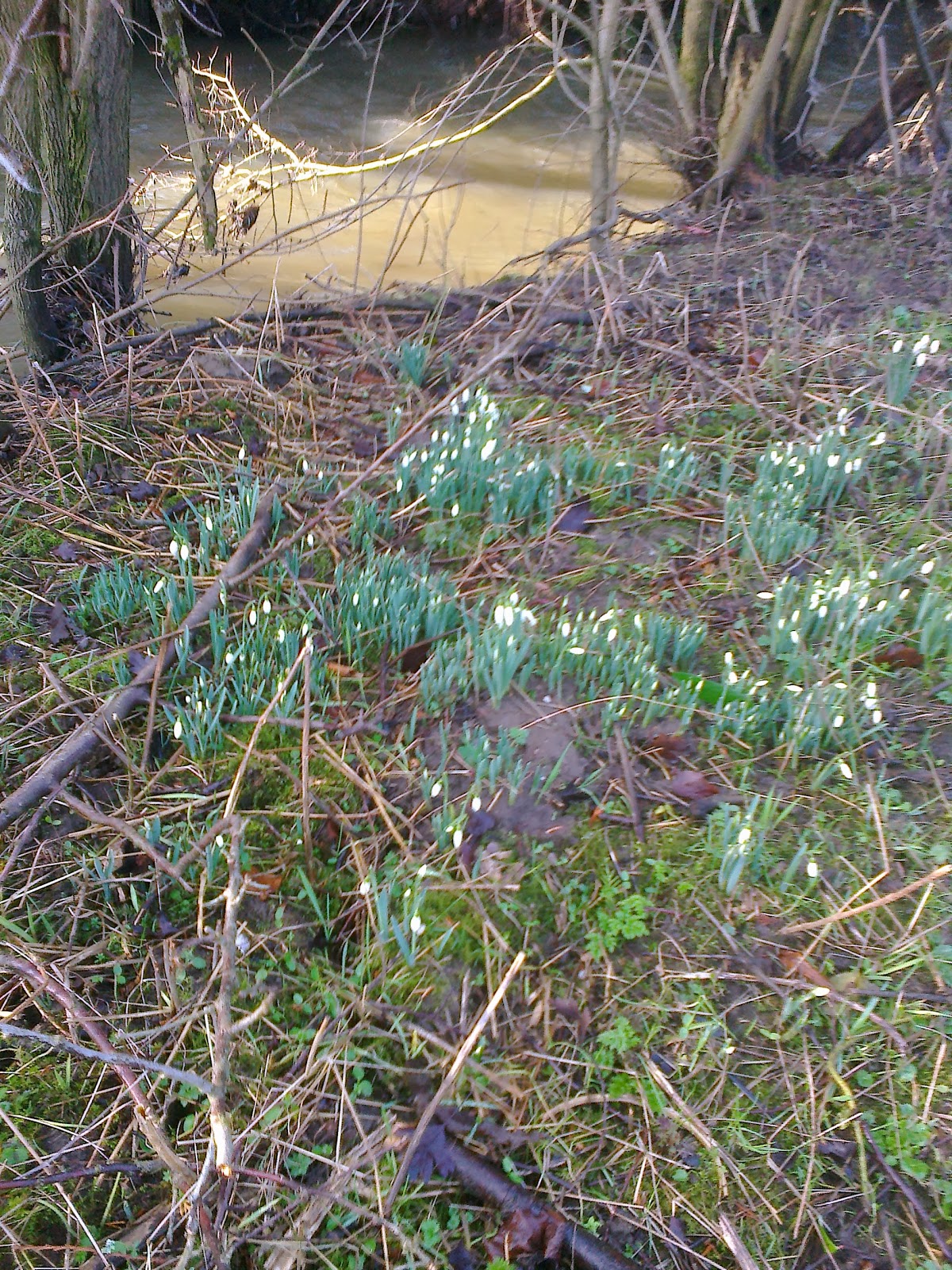
Snowdrops at Turnditch Orchard

There's signs of Spring already at the orchard. We found these snowdrops poking their heads above the soil on the first day of February. Behind the flowers you can see the Ecclesbourne swollen by the recent rains.

Snowdrops beside the Ecclesbourne
Snowdrops by the Ecclesbourne

Sunday, 26 January 2014

Rotten trees in the roadside hedge

The fencing contractors employed to install the wire stock fence, on the roadside of the orchard site, cut back some of the hedge bushes. This was fine by us. They needed relatively straight lines of sight for the fencing process which involves tensioning the wire. 

However the trimming back exposed several small trees of up to 15 cm (6 in) diameter which were rotten through to the core. I was able to push these trees over by hand. They then fell down the embankment into our field site. It would not have been good if winds had pushed them in the opposite direction on to the road. It is yet more urgent work needed to tidy the woodland on the embankment. The rotten trees were mostly Elm and Hawthorn. I'll collect the rotten trunks and store them either on the embankment or in a corner of the field so any wood boring grubs inside are not disturbed.

We'd intended to do this tidying work during November and December of last year but the temporary loss of my driving licence (a single 30 second blackout) has greatly impaired our ability to transport equipment to the site. Hopefully the Government officials will decide I've been punished enough for the single isolated health event and return my licence to me. Otherwise progress on the work of setting up the orchard will be impaired. It is unlikely the orchard will ever generate enough income to pay for the extensive use of contractors. There's just a couple of months left before the birds nesting season starts which will put a stop to any major works in the woodland.


Friday, 24 January 2014

Planting the Willow

Today we were hard at work planting 100 willow wands (1.5 Metres tall) on the Orchard site.  We've planted Salix Viminalis which is a fast growing native plant. It will grow about two metres higher in the first year. We'll prune it in the late autumn of 2014 to encourage side growth.

Planting Willow.
Planting willow wands

We planted the wands through metre wide woven textile membrane which you can see in the picture above. The membrane mat is laid on the ground and will suppress other plants which might compete with the willow as it establishes its root system in the ground. The edges of the membrane have been pinned down with special plastic pegs driven into the ground. Later we'll cover the membrane with wood chippings.

We're protecting the base of willow with clear plastic spiral tubes. This will help to prevent damage from rabbits nibbling the bark, We've planted the willow grove close to the line of the ditch which has been filled in during previous owners of the land. The wands are planted about 50 cms apart.

Aside from the usual mix of birds we saw a grey squirrel and a mouse (or vole?) on the land today.

Complete planting of willow
Complete 100 wands planted

Wednesday, 22 January 2014

Early signs of spring

The river is still in spate today after the heavy rain over the past few weeks. The picture below shows the current level and some debris from a fallen tree.  This picture was taken from the road bridge. We're planing to clean the bank side and remove many of the failed trees. In their place we'll be planting some willow to consolidate the banks Their thick roots can withstand water logging in the soil and will dig down deeply binding the soil against flood erosion.


We noticed some snowdrop flowers on the field under the hedges and also in the open ground. You'd not normally find snowdrops in fields grazed by farm animals as they may be toxic. It is a further suggestion that some garden soil has been dumped on the field. I also noted some buds were beginning to swell on some of the twigs. Let's hope there not a cold spell in February to burn this sign of life.